
How long does a Munro take?
Naismith's 1892 rule assumes a light pack and a firm path. Scottish bog and wind add hours.
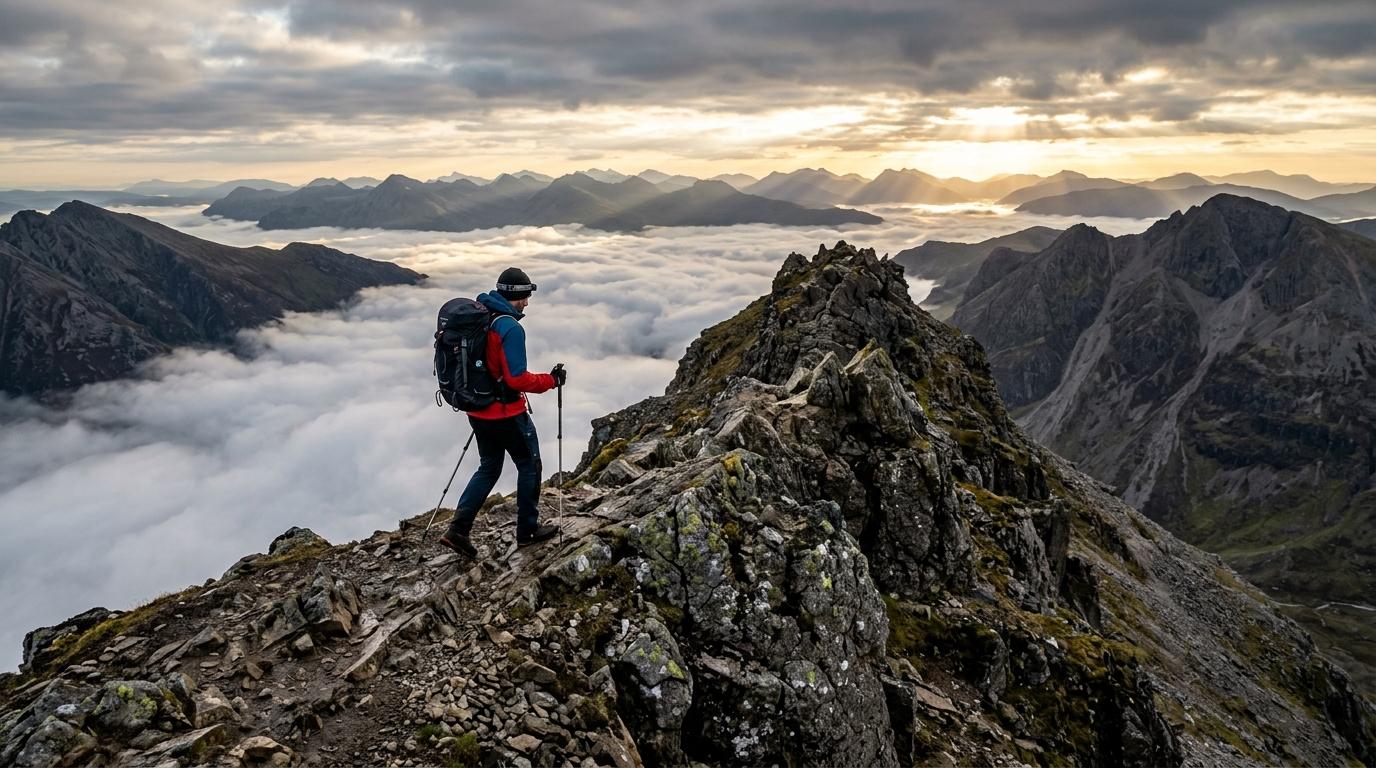
Essential Field Takeaways
- Naismith's classical formula (1892): 1 hour for every 5 km horizontal + 1 hour for every 600 m of ascent.
- Aitken / Langmuir corrections: add 1 hour per 300 m on steep descents >20 degrees to account for knee impact and scree.
- Peat tussock and bog terrain reduces horizontal speed from 5 km/h to 2.5–3.2 km/h.
- Sustained 40+ mph head-winds increase pacing time by an additional 20% to 35%.
- Always compare your total estimated elapsed time against our live Daylight Clock to avoid descent in the dark without a headtorch.
The Historical Baseline
In 1892, Scottish mountaineer William Naismith published his famous rule of thumb in the Scottish Mountaineering Club Journal: allow 1 hour for every 3 miles (approx. 5 km) on the flat, and add 1 hour for every 2,000 feet (approx. 600 metres) of ascent.
For a fit hillwalker carrying an 8-litre daypack on a well-graded gravel stalkers' path (such as the Ben Nevis Mountain Track), Naismith's rule is remarkably accurate. But the moment you leave maintained trails to cross the trackless tussocks of the Monadhliath or the bogs of Knoydart with a 16 kg wild-camping pack, the classic formula fails catastrophically.
The Realistic Highland Multipliers
Our interactive Route Pacing Calculator applies three critical friction coefficients to the baseline Naismith formula:
**1. Terrain Penalty**: Firm estate tracks run at the full 5 km/h baseline. Rough mountain trails reduce speed to 4.2 km/h. Trackless heather and sodden peat bogs cut forward progress to 2.8 km/h.
**2. Pack Weight Factor**: Carrying a standard multi-day backpacking rucksack (14–18 kg) imposes an additional 12% to 20% time penalty on all vertical ascent.
**3. Gale Gust Drag**: Fighting continuous 35–50 mph summit winds consumes enormous muscular energy and forces cautious, wide-stance footing, adding up to 25% to ridge crossing times.
| Route Type | Distance & Ascent | Classic Naismith | Real Highland Adjusted Time |
|---|---|---|---|
| Ben Nevis Mountain Track (Firm Day Pack) | 17 km, 1,350 m | 5h 30m | 5h 45m – 6h 15m |
| Carn Mor Dearg Arête (Scramble) | 18 km, 1,500 m | 6h 00m | 7h 30m – 8h 30m |
| Fisherfield 6 Munros (Wilderness Bog) | 30 km, 2,250 m | 9h 45m | 13h 00m – 15h 30m |
| West Highland Way - Rannoch Moor Stage | 19 km, 350 m | 4h 15m | 5h 00m – 5h 30m (heavy pack) |
Interactive Route Pacing Calculator
Input your custom route distance, vertical ascent, terrain surface, and pack weight to see your daylight window.
Recommended Further Reading
Where and when to see the Hogwarts Express in Scotland
The Jacobite steam train, the Hogwarts Express in the Harry Potter films, runs on the West Highland Line between Fort William and Mallaig. It crosses the Glenfinnan Viaduct, a 21-arch curved stone bridge about 15 miles west of Fort William on the A830. In the 2026 season the morning train leaves Fort William at 10:15, and the afternoon train at 12:50 while that service is running.
Trip PlanningCan you walk the West Highland Way in 5 days?
The West Highland Way is about 154 km. Five days means about 30 km a day on paper, and two days near 42 km in practice, one of them on the rocky east shore of Loch Lomond. It suits a fit walker with booked beds and a light pack. A first long walk, or a full camping pack, belongs on the 7-day plan.