
Trail runners or boots for hiking in Scotland
In Scottish peat bogs, waterproof membranes don't keep water out. They keep it in.
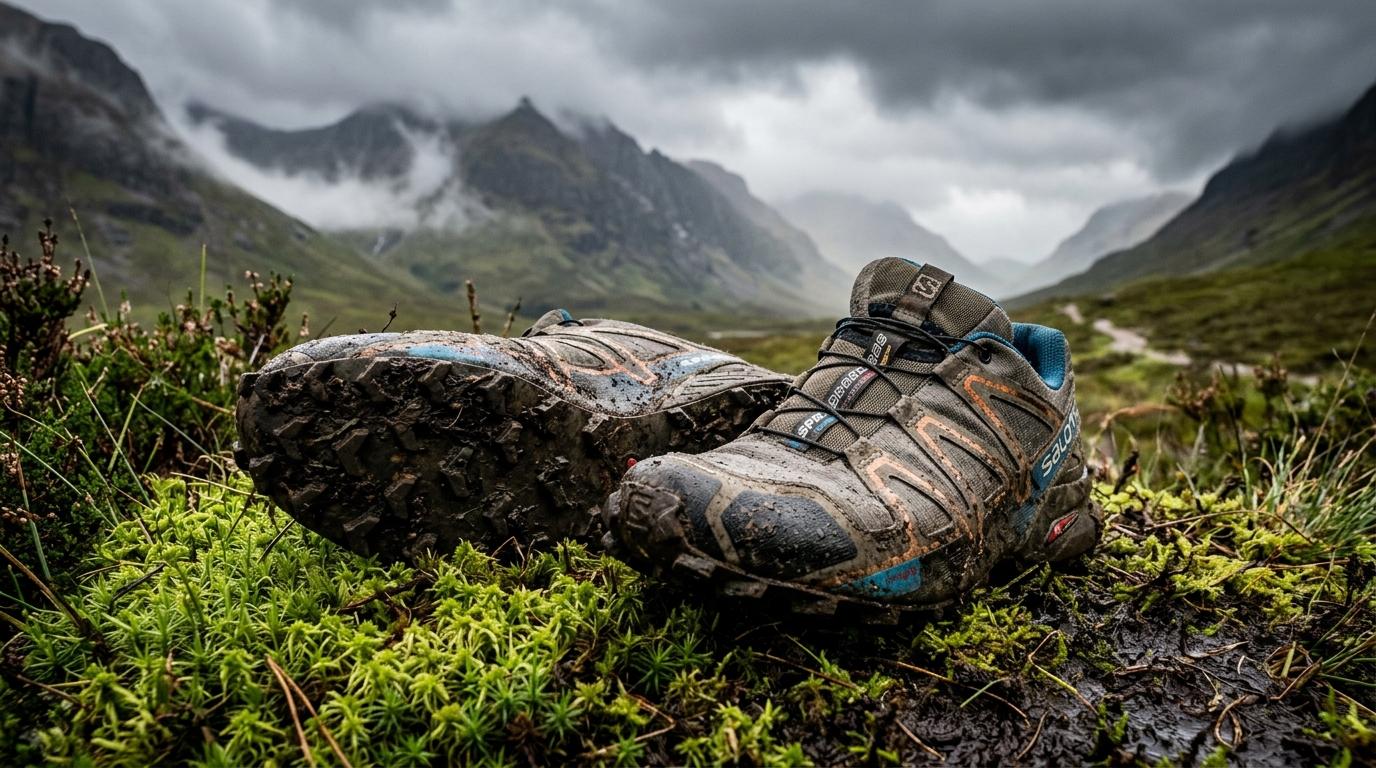
Essential Field Takeaways
- Waterproof membranes inevitably flood from the top during deep peat bog plunges or unbridged river crossings.
- Once flooded, Gore-Tex boots trap water like buckets and will never dry inside a tent or damp bothy.
- Mesh trail runners drain within 50 paces, weigh half as much when wet, and dry out rapidly overnight.
- Pair non-membrane trail runners with neoprene socks (e.g. DexShell or Sealskinz) for warmth even when submerged.
- Reserve rigid B1/B2 mountaineering boots exclusively for winter conditions, snowpack, or technical winter scrambles.
The Traditional Myth of the Waterproof Boot
For decades, conventional outdoor gear advice in Britain dictated that to venture into the Scottish Highlands, you required heavy, high-ankle leather boots with a Gore-Tex membrane. This advice works reasonably well for well-drained alpine stone paths or short day walks in gentle drizzle. However, in the vast, saturated peat hags of Rannoch Moor, the Knoydart peninsula, and the Trotternish Ridge, it collapses.
Highland peat bogs are not puddles. They are complex hydraulic blankets where you will frequently sink calf-deep or knee-deep. When you step into a bog hole deeper than 6 inches, water crests the boot cuff instantly. At that exact moment, your boot's waterproof membrane ceases to be a barrier against moisture—it becomes an impermeable barrier preventing water from ever leaving.
The Sluice Effect
A flooded size 10 leather boot can retain up to 600 ml of trapped water per foot. Carrying that excess mass through 25,000 steps equates to lifting an extra 15 tonnes of dead water weight every single day.
The Mesh Runner + Neoprene Sock Philosophy
Modern long-distance trekkers on the West Highland Way, Cape Wrath Trail, and Skye Trail have overwhelmingly switched to non-waterproof mesh trail runners. A shoe with wide-gauge mesh has no solid barrier to hold water. Within 50 strides of stepping out of a river or bog, the hydraulic pumping action of your stride expels 90% of the standing water through the mesh.
The crucial companion to the mesh trail runner is the sock strategy. In shoulder seasons or cold Highland rain, wear a high-cuff waterproof sock (such as DexShell Hytherm Pro or Sealskinz) or a 2mm neoprene dive sock. The shoe gets wet, but your foot remains warm and dry inside the sock. If water eventually enters the sock cuff on a deep river ford, neoprene retains body heat through wet-suit thermoregulation, preventing trench foot and blistering.
| Attribute | Gore-Tex Leather Boot | Mesh Trail Runner + Neoprene Sock |
|---|---|---|
| Dry Weight (pair) | 1,500g – 1,800g | 600g – 750g |
| Wet Weight (post-immersion) | 2,400g+ | 900g – 1,050g |
| Drain Time After Submersion | Hours (or never without inversion) | 30 to 60 seconds of walking |
| Drying Time Inside Tent | 36–48 hours | Overnight under vestibule |
| Blister Probability in Bog | High (skin maceration from pooled water) | Low (reduced friction & free drainage) |
| Ideal Terrain | Winter snow, crampons, loose scree | Peat bog, marked trails, river-crossing routes |
When Boots are Still Mandatory
Trail runners are not universal. As soon as temperatures plummet below freezing and the freezing level drops to 600 metres, soft trail running soles become dangerous. You cannot kick reliable steps in hard-packed neve with flexible EVA foam midsoles, and strap-on microspikes will roll off flexible shoes on steep gradients.
If your objective involves winter Munro bagging, crossing the Aonach Eagach ridge, or winter ascents of Ben Nevis, rigid B1 or B2 rated mountaineering boots with full-length steel shanks and front welts for C2 crampons are essential for survival.
Decision Rule of Thumb
If there is snow or ice requiring crampons, wear B1/B2 boots. For everything else between April and October in the Scottish Highlands, mesh trail runners provide superior ergonomics, speed, and foot health.
Interactive Footwear Decision Engine
Test your specific Highland route, season, bog saturation, and pack weight to find your exact footwear recommendation.
Recommended Further Reading
Can the Badger Divide be ridden on a gravel bike?
The Badger Divide can be ridden on a gravel bike. It is about 340 km with 5,200 m of climbing: 38% smooth gravel, 14% tarmac, 38% rough track, and about 10% hike-a-bike. A bike that clears 47–50 mm tyres finishes it. The checker on this site still recommends a hardtail, because that rough share is high.
Trip PlanningWhere and when to see the Hogwarts Express in Scotland
The Jacobite steam train, the Hogwarts Express in the Harry Potter films, runs on the West Highland Line between Fort William and Mallaig. It crosses the Glenfinnan Viaduct, a 21-arch curved stone bridge about 15 miles west of Fort William on the A830. In the 2026 season the morning train leaves Fort William at 10:15, and the afternoon train at 12:50 while that service is running.