
River crossings on the Cape Wrath Trail and Skye Trail
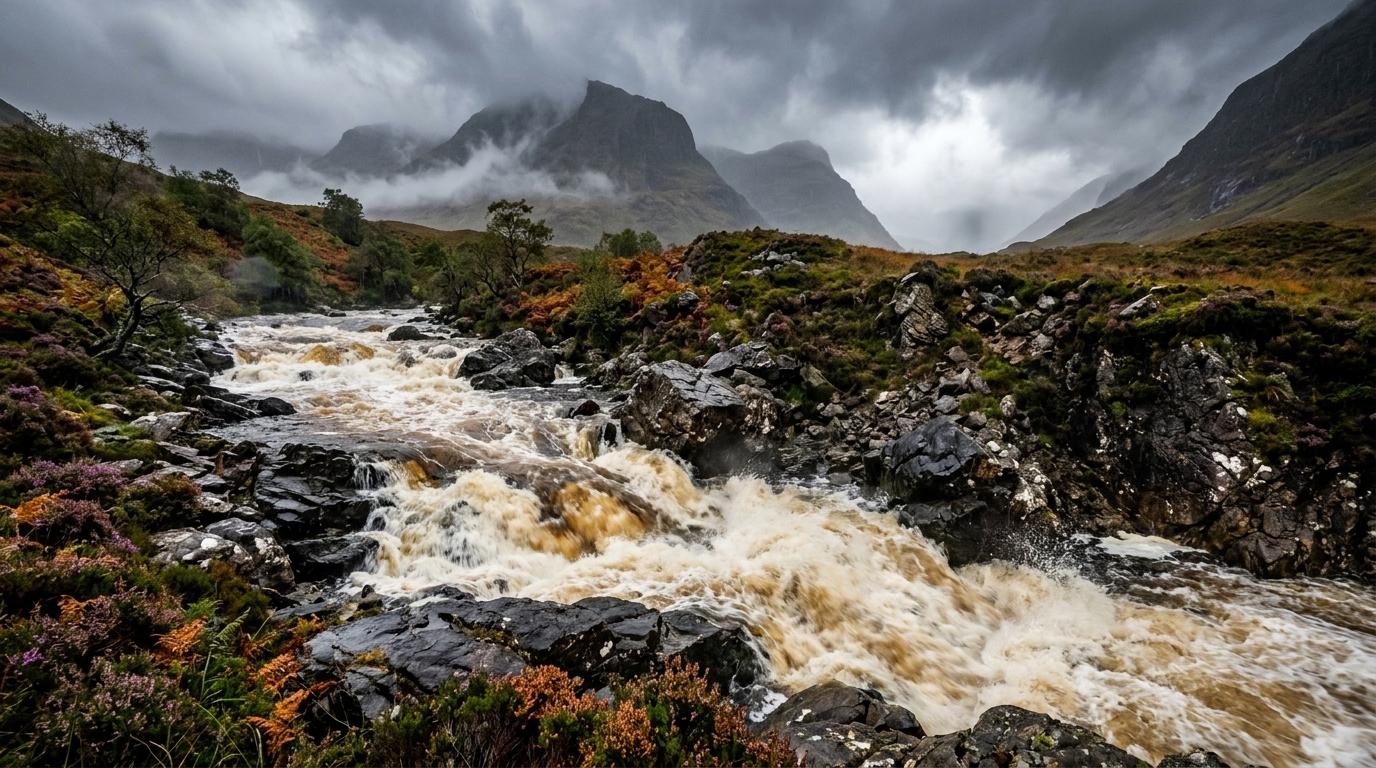
A Highland burn can rise from ankle-deep to chest-deep in under three hours.
Essential Field Takeaways
- Peat catchments have virtually zero water retention; intense rain runs off bedrock straight into burns within 60-120 minutes.
- Listen for grinding boulders underwater: if you hear stones rumbling under the surface, river kinetic energy is deadly.
- Always unclip your rucksack waist and chest buckles before wading: if you fall, a buckled 15kg pack will pin you face-down.
- Never cross above a waterfall, strainer of fallen trees, or class 3+ rapids.
- Turning back or waiting 4 to 8 hours for the peak flood pulse to subside is always better than risking a fatal sweep.
The Hydrology of a Highland Spate
Unlike chalk rivers in southern England or deep gravel basins in Europe, the Scottish Highlands sit on impermeable metamorphic and igneous bedrock overlain by waterlogged blanket bog. When a maritime storm dumps 40 to 80 mm of rain over the western mountains, the soil cannot absorb it.
Water runs immediately into mountain burns. A stream that was 4 inches deep when you crossed in the morning can easily transform into a roaring, peat-black torrent 4 feet deep with immense hydraulic pressure by 3 PM.
The Clatter of Riverbed Boulders
If you approach a swollen burn and can hear muffled clunking or rumbling beneath the roar of the water, bedload gravel and heavy boulders are rolling downstream. Crossing is strictly suicidal; do not enter.
The burns that catch people out
The same rise shows up on routes that look ordinary in the morning. The Water of Nevis in Glen Nevis, the unbridged fords in Glen Feshie, and the burns on the Skye Trail can go from a simple step to a stop within about 90 minutes of heavy rain. Peat and rock do not hold the water. If the afternoon is forecast wet, cross early or do not count on the ford.
A bridge is the route. A line of stepping stones is a fair-weather path. If you can hear stones moving on the bed, stay on the bank you are already on. Waiting a few hours is the decision that keeps the day ordinary. The Cape Wrath Trail is the long walk where this happens more than once. It is not the only one.
Wading Technique When Crossing is Feasible
If water is knee-deep or lower and moving at a moderate pace, inspect the river for the widest, braided section rather than the narrowest gorge (wide points are shallower and slower).
Follow these essential safety steps:
1. **Unclip Hip Belt and Sternum Strap**: This is non-negotiable. If you lose footing, an attached rucksack acts as an anchor that flips you onto your stomach with your head forced under. Unclipped, you can shrug the pack off immediately.
2. **Keep Shoes On**: Never cross barefoot. River stones in Scotland are covered in slippery black algae and sharp quartz shards. Wet shoes dry; shattered ankles do not.
3. **Face Upstream at a 45-Degree Angle**: Lean slightly into the current, using two extended trekking poles as tripods to maintain three points of contact at every step. Move sideways crab-style.
Live River Spate & Ford Warning Alert System
Monitor hydrological spate risk indices and affected crossings across Nevis, Cairngorms, Glen Coe, and Skye.
Recommended Further Reading
Can you drink from a Highland burn?
Do not drink straight from a Highland burn. Sheep, cattle, and red deer, including carcasses upstream, contaminate clear water with bacteria, Giardia, and Cryptosporidium. Use a 0.1 to 0.2 micron hollow-fibre filter or boil it. Peat silt clogs a Sawyer Squeeze quickly, so pre-filter through a cloth and back-flush. Collect from a fast gravel burn, not a still pool.
Weather & HazardsCape Wrath Trail: how many days, and how you get out
The Cape Wrath Trail is about 370 km of pathless ground from Fort William to the cape. Plan 12–18 days, carry a tent, and check that the Keoldale ferry and minibus are running before you depend on them.