
NC500 single-track roads and passing places
Give way on the left, let locals past, and do not park in a passing place.
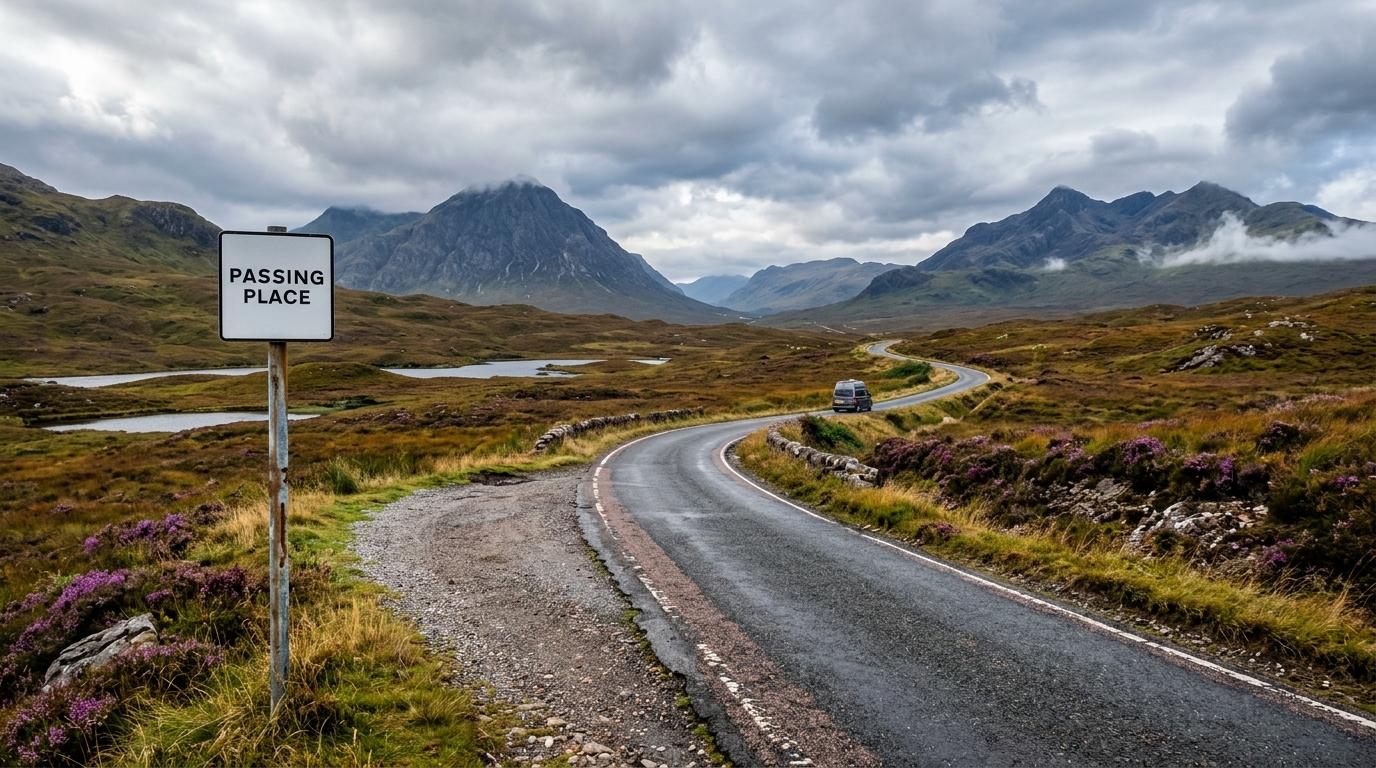
Essential Field Takeaways
- Rule 1: Always give way to the LEFT. Pull into a passing place on your left side; never cross onto the opposite side.
- If the passing place is on your right, wait stationary directly opposite it on your own left lane so oncoming traffic can pull into it.
- Rule 2: Allow trailing traffic to overtake. Delivery drivers, doctors, and local residents have urgent business—indicate left and pull over.
- Rule 3: NEVER park, wild camp, or stop for photography in a passing place. It is a live carriageway under the Roads (Scotland) Act 1984.
- Always acknowledge passing drivers with a friendly Highland hand wave or headlight flash.
Why Single-Track Etiquette Matters
The North Coast 500, the Isle of Mull, and the remote glens of Wester Ross contain hundreds of miles of single-track roads: asphalt wide enough for exactly one vehicle, punctuated every 50 to 150 metres by passing places marked with square white or diamond-shaped signs.
To tourists, these roads are scenic novelties. To local crofters, nurses, school buses, posties, and retained volunteer fire crews, they are critical lifelines. Misunderstanding passing places creates frustrating gridlocks and can directly impede emergency responses.
Legal Reality Check
Passing places are designated dynamic traffic management zones under the Roads (Scotland) Act 1984. Parking a campervan or pitch-camping in a passing place is illegal, blocks emergency services, and invites immediate police fines.
The Three Ironclad Rules of Passing Places
**Rule 1: The Left-Hand Rule** Always pull into the passing place on your **LEFT**. If you see an approaching vehicle and the nearest passing place is on your right-hand side, **do not cross over onto the wrong side of the road**. Instead, stop your vehicle directly opposite the passing place on your own left side, leaving the bay open for the oncoming car to enter.
**Rule 2: The Reversing Protocol** Look ahead down the road. If you meet an oncoming vehicle, the driver with the nearest passing place behind them is expected to reverse into it. If you are driving a small passenger car and the oncoming vehicle is a 3.5-tonne motorhome, timber lorry, or vehicle towing a trailer, reverse courteously even if you have slightly further to go—manoeuvring large vehicles backwards on winding roads causes dangerous delays.
**Rule 3: Let Faster Traffic Overtake** Driving at 20 mph while admiring mountain scenery is wonderful, but holding up a queue of four vehicles behind you is unacceptable. Check your rear-view mirror every 30 seconds. If a vehicle approaches from behind, signal left at the next passing place, come to a complete halt, and let them pass cleanly.
| Scenario | Correct Action | Forbidden Mistake |
|---|---|---|
| Passing bay is on your LEFT | Indicate left, pull smoothly into the bay, wait for oncoming vehicle. | Speeding up to beat oncoming car to the next bay. |
| Passing bay is on your RIGHT | Stop on the left side of the carriageway directly opposite the bay. | Crossing into the oncoming lane and waiting in their bay. |
| Faster local driver appears behind you | Indicate left, stop in next passing place, wave them past. | Ignoring rear mirror and building a 10-car convoy. |
| Stunning vista next to passing place | Drive forward until you find a designated off-road lay-by. | Stopping in the passing place with hazards on for photos. |
The Highland Wave
When an oncoming driver stops to let you through, or someone reverses into a bay for you, always acknowledge them. A raised hand from the steering wheel or a brief headlight flash during daylight is universal currency across the Highlands and Islands.
NC500 & Single-Track Passing Place Visual Guide
Review interactive diagrams, reversing protocols, and campervan waste disposal points across Scotland.
Recommended Further Reading
ScotRail bike reservations on the West Highland Line
Bikes must be reserved on the West Highland Line and on trains between the cities and Inverness. Book the space when you buy the ticket, on the ScotRail site or app. The Highland Explorer carriage on the West Highland Line holds 20 cycles. If those spaces are gone, another service, a station further along the route, or a courier to a shop that has agreed to take the bike are the backups. Turning up and hoping is how people get left on the platform.
Logistics & VanlifeWest Highland Way resupply: where the shops actually are
Full food shops on the West Highland Way are the supermarkets at Milngavie, the Co-op in Kinlochleven, and Morrisons and Lidl in Fort William. Village shops fill some of the gaps and close early, especially on Sunday. From Tyndrum to Kinlochleven, about 55 km, Bridge of Orchy and Kingshouse have hotels and no grocery shop. Carry those two days, and buy stove gas before Milngavie.