
Scottish midge forecast: when they bite and what stops them
Wind over 6 mph grounds the swarm. Still, humid evenings do not.
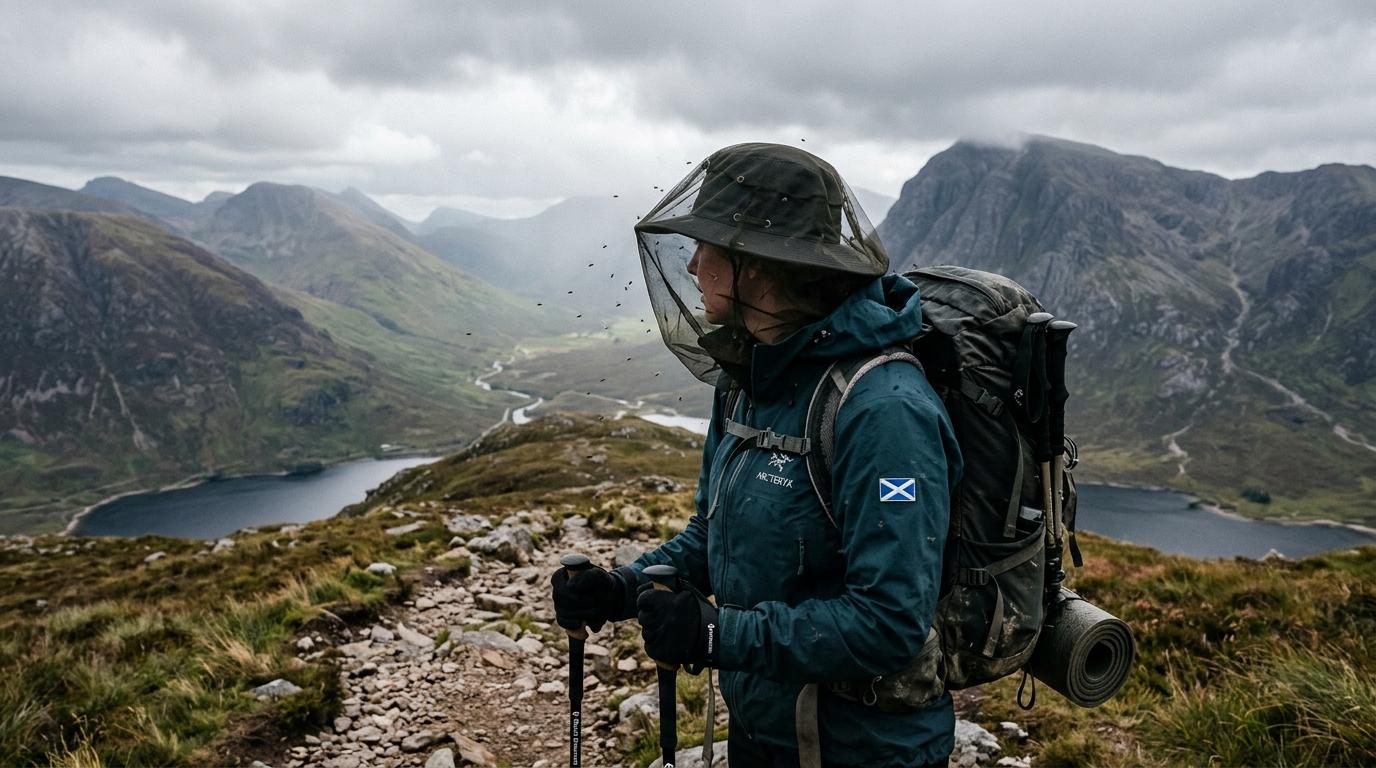
Essential Field Takeaways
- Midges cannot sustain flight when sustained wind exceeds 6 mph (2.7 m/s or ~5.2 knots).
- The season is late May through September, busiest in June, July, and August. September can still bite in a still glen.
- Overcast skies, high relative humidity (>75%), and temperatures between 10°C and 22°C are when they bite. The worst of it sits around 12°C to 18°C.
- Camp on exposed, breezy knolls, ridges, or coastal headlands rather than sheltered, tree-lined glen bottoms.
- Ticks are active in the same months, in bracken and long grass. Check at the end of the day and carry a tick remover.
The Aerodynamics of the Scottish Midge
The Highland biting midge (*Culicoides impunctatus*) accounts for roughly 90% of all biting insect encounters in the Scottish hills. Despite their ferocious reputation, midges are physically frail creatures measuring only 1.2 to 1.4 millimetres in length. Their wing-beat frequency is rapid (around 1,000 beats per second), but their mass is so minuscule that any steady airflow completely disrupts their ability to orient and lock onto human carbon dioxide plumes.
Extensive meteorological and entomological research has determined that a sustained wind speed of **6 mph (2.7 m/s or 10 km/h)** is the critical tipping point: at or above this threshold, midge swarms are grounded. Even brief gusts above 8 mph dislodge them from tents and exposed skin.
The Wind Rule for Pitching Your Tent
When wild camping between June and September, avoid idyllic, sheltered mossy dells beside flat riverbanks. Pitch on a well-ventilated knoll, col, or coastal headland where prevailing breezes stay above 6 mph all night.
Atmospheric Triggers: The Clag Correlation
Midges are acutely vulnerable to desiccation. In bright, clear sunshine with low humidity, solar ultraviolet radiation and dry air can kill them within minutes. Consequently, they remain dormant in the damp understory of bracken, sphagnum moss, and heather roots during midday bluebird days.
They struggle below about 10°C and fade once the air is warmer than about 22°C, especially in dry sun. The busy band is the middle of that. When low-pressure weather brings cloud down to glen level (Scottish clag), relative humidity surges above 80%, and the temperature sits around 12°C to 18°C, the whole glen becomes a feeding corridor.
| Midge Activity Level | Wind Speed | Humidity | Sky Condition | Human Action Required |
|---|---|---|---|---|
| Index 1 - Negligible | > 10 mph | < 60% | Direct sun / bright breeze | No repellent or head net required. |
| Index 2 - Minimal | 7 - 10 mph | 60 - 70% | Partly cloudy | Occasional stragglers in sheltered pockets. |
| Index 3 - Moderate | 5 - 7 mph | 70 - 80% | Overcast / breezy lulls | Apply Saltidin/Smidge repellent to wrists & neck. |
| Index 4 - Severe | 3 - 5 mph | 80 - 90% | Still clag / humid drizzle | Head net mandatory; cook inside tent vestibule. |
| Index 5 - Swarm | < 3 mph | > 90% | Dead calm, dusk/dawn gloom | Full sealed micro-mesh, zero skin exposure. |
Repellent Chemistry: Why DEET Fails Against Midges
Many travelers arriving from North America or continental Europe rely on high-concentration DEET sprays. While DEET is effective against tropical mosquitoes, midges respond far better to Saltidin (also known as Picaridin/Icaridin) formulations, such as the Scotland-manufactured *Smidge*.
Saltidin blocks midge sensory antennal receptors without melting synthetic rain jackets, watch faces, or nylon tent fabrics—a notorious side-effect of 50%+ DEET sprays. Always pack a fine 0.6mm midge head net in an accessible top pocket of your pack before setting foot in the Highlands.
Which months they actually bite
The months without a midge problem are November to April. May is the start, in still glens. June, July, and August are the season people mean, at dawn and dusk and on still wet days. September can still bite. A windy week in those months is close to a winter day for midges, because they cannot fly in a sustained wind over 6 mph. A still, damp week is the one to avoid if the trip is a glen camp rather than a windy ridge.
The live index on the conditions page answers today: wind over 6 mph, low humidity, or a cold hour, and they are grounded. The month only tells you whether to pack the net.
| Month | What to expect | What to pack |
|---|---|---|
| November–April | No midge season | Skip the net |
| May | Starting, worst in still glens | Net in the pack |
| June–August | The main season, dawn and dusk | Net, Smidge, long sleeves at camp |
| September | Fading, not finished | Still take the net |
| October | Odd mild evenings only | Net if the week is warm and still |
Ticks, the insect the midge threads forget
People search for midges and then get home having thought about nothing else. Ticks are the other one. They sit in bracken, long grass, and heather, and they are active in the same warm months, including September. They are easier to miss because they do not swarm.
Wear trousers on overgrown ground, check skin at the end of the day, and carry a tick remover. Lift the tick out close to the skin without squeezing the body. If a rash or an illness follows a bite, get medical advice. That is the whole kit. It weighs less than a head net.
Check on the night you camp in grass
A path day is lower risk than a pitch in long grass or bracken. Look behind knees, at the waistband, and at the hairline before you sleep.
Live Highland Conditions Matrix & Midge Index
Check live wind gusts and real-time midge flight suppression forecasts across Ben Nevis, Cairngorms, Glen Coe, and Skye.
Recommended Further Reading
Can you drink from a Highland burn?
Do not drink straight from a Highland burn. Sheep, cattle, and red deer, including carcasses upstream, contaminate clear water with bacteria, Giardia, and Cryptosporidium. Use a 0.1 to 0.2 micron hollow-fibre filter or boil it. Peat silt clogs a Sawyer Squeeze quickly, so pre-filter through a cloth and back-flush. Collect from a fast gravel burn, not a still pool.
Weather & HazardsCape Wrath Trail: how many days, and how you get out
The Cape Wrath Trail is about 370 km of pathless ground from Fort William to the cape. Plan 12–18 days, carry a tent, and check that the Keoldale ferry and minibus are running before you depend on them.